
Human Moats: The Next Competitive Advantage
Where Competitive Advantage Now Lives
Two companies can have the same data, the same tools, and similar talent - and still produce radically different outcomes. That gap is where competitive advantage now lives.
In the lower and mid-market, this gap is even more pronounced.
These companies are highly exposed to AI-driven change and least resourced to respond to it. But they are also the most adaptable. So the question becomes … can the organisation adapt fast enough to stay relevant?
The existing thought leadership in this space points to the same issues - decision quality, speed, leadership capability, execution risk. I was intrigued to go a bit deeper. How do organisations actually work?
Defensibility Is Being Rewritten
This is a nuanced subject that varies by sector, business model, growth stage. From 2019-22, there was an emphasis on proprietary data and algorithms. The OpenAI shift introduced a spectrum of views that can be succinctly summarised as more emphasis on proprietary data as algorithms became commoditised.
Investors saw hype, confusion and very questionable ROI. The technology accelerated far faster than OKRs and organisational designs. The workplace has advanced at lightspeed from perhaps 5% of the organisation playing around with this ‘new intelligence’ to 100%.
This raises structural questions around the ‘secret sauce’ of the company. What their people do best, what they leave entirely to AI and where they have deemed human/AI alchemy to be optimal. AI compresses execution. It amplifies judgment. And judgment sits in uniquely configured humans.
This raises a new question for investors. Not just what a company does but how value is created inside it. Where judgment is applied, where it is missing, and where it is misallocated.
Most businesses are constrained by how decisions are actually made day to day. Not strategy or tech.
The Founder as the Operating System
In a previous blog, I covered authentic leadership and AI-first vs Human-first organisations. One interesting theme was that, in many instances, the founder is the company.
It stands to reason then that visionary and strong leaders need high-levels of self-awareness. In the AI-era I expect we will see founders, CEOs and leadership teams becoming a little more introspective to better understand their own identity and working chemistry.
My own personal career journey, and one framework in particular, has been incredibly instructive as a self-awareness lens and a compass to point me toward new terrain.
Understanding Human Configuration
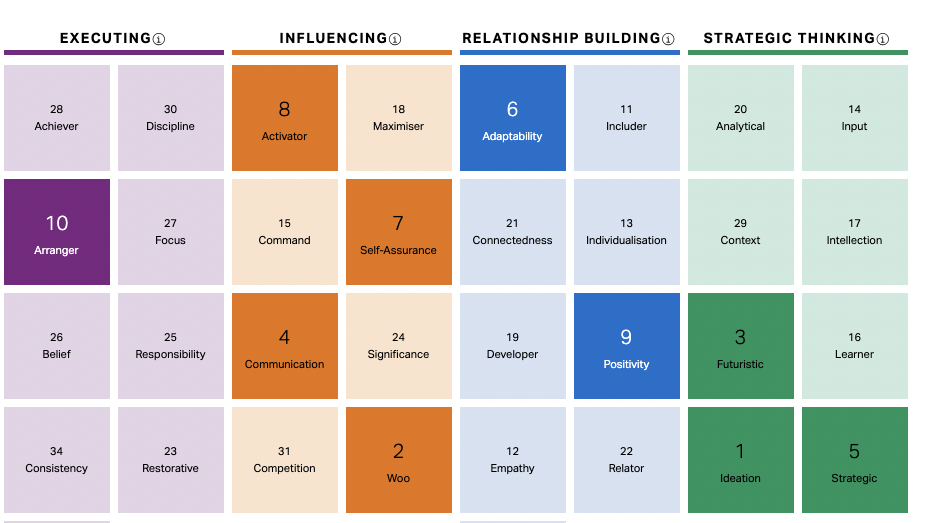
What you see above is my version of a ranked list of 34 human attributes. The highest-ranked attributes are the ones that give me energy and shape how I think and work. You can begin to see patterns and make conclusions … I like upstream conceptual/strategic thinking, people, ideas, thinking about the future. For everyone in the workplace, AI shifts the balance across the four domains - outer two commoditised/augmented. More emphasis on the middle two.
If leaders examined themselves, it’s likely that this would lead to different conversations with investors about the leadership team and growth plan. What matters is not individual strengths, but how they combine. Every leadership team, and every organisation, is a unique configuration.
Human Moats
Of course humans are unique. The number of human combinations is 2.95 × 10³⁸. For the CEO of a 500 person company, there’s a 99.6% chance that everyone’s ordered Top 5 is unique.
That means value is not created by roles. It is created by how those individuals are combined, deployed, and amplified. So AI increases the return on human difference. Investors will start thinking about configuration advantages. Clearly, human difference is a hard thing to diligence so maybe leaders will want to get on the front foot here.
I call this Human Moats. This is what investors are actually buying. The non-replicable way an organisation:
Makes decisions under pressure
Allocates attention across competing priorities
Combines different types of people to solve problems
The New Unit of Value
If the unit of value shifts from: Role → Individual + AI system
Then differences between individuals matter more, not less. You don’t want uniform capability. You want differentiated individuals - deliberately combined to create disproportionate outcomes.
Where Innovation Actually Comes From
Great companies innovate. Innovation is not evenly distributed across organisations.
It tends to sit with individuals who think non-linearly, who connect ideas, recognise patterns early, and challenge assumptions. These individuals can be misallocated, placed into roles that optimise for execution rather than exploration.
When that happens, potential innovation is lost before it even surfaces. AI amplifies this dynamic. It reduces the cost of exploring ideas and testing hypotheses, but it does not decide which ideas are worth pursuing.
In practical terms, this shows up as missed opportunities: new products not pursued, better strategies not identified, emerging risks not recognised early enough.
Where Value Is Won and Lost
If it holds that the real constraint is how an organisation actually works, leaders need to be increasingly focused on where there is value leakage:
How quickly decisions are made
How aligned teams are
Whether priorities are clear
How quickly organisations adapt
A culture that embraces the discomfort of seeking the truth
There is a risk that the organisation slows down as we become immersed in impressive looking noise. Shallow thinking masquerading as groundbreaking insight. This creates a gap in most organisations. Not in execution but in understanding. Few leaders have a clear view of how value is actually created inside their business and how that is changing in real-time. That is becoming a strategic problem.
Clearly, stakeholders will have differing perspectives on the metrics that determine ‘great companies.’
For me, this is about energised, committed people with a sense of an evolving career purpose/destiny with emerging clarity how AI intersects with this. It needs to be married in practical terms with the mechanics of value creation (high-quality decisions, allocation of talent to highest value problems, clearer prioritisation under pressure, consistent execution).
If leaders can authentically grapple with both topics then they have a fighting chance of hitting the traditional success/growth metrics that investors care about.
Performance Is Patterned, Not Uniform
Perhaps we should think in performance patterns. In my case I would be a high-connection, high-ideation, high-influence profile. This means that I generate ideas, read people deeply, communicate and influence, and create momentum.
We have combinations of strengths and those combinations behave very differently depending on the environment. AI interacts with those combinations unevenly.
Great Companies of the Future
The future of work isn’t about mapping jobs to AI risk. It is about understanding how people actually create value in your organisation and how this is changing. The companies that outperform will study this and design around it.
They will also consistently make better decisions, allocate their best people to the highest-value problems, and adapt faster than everyone else.
That requires understanding how the organisation actually works - not how it appears on paper.
That is the new competitive advantage.